
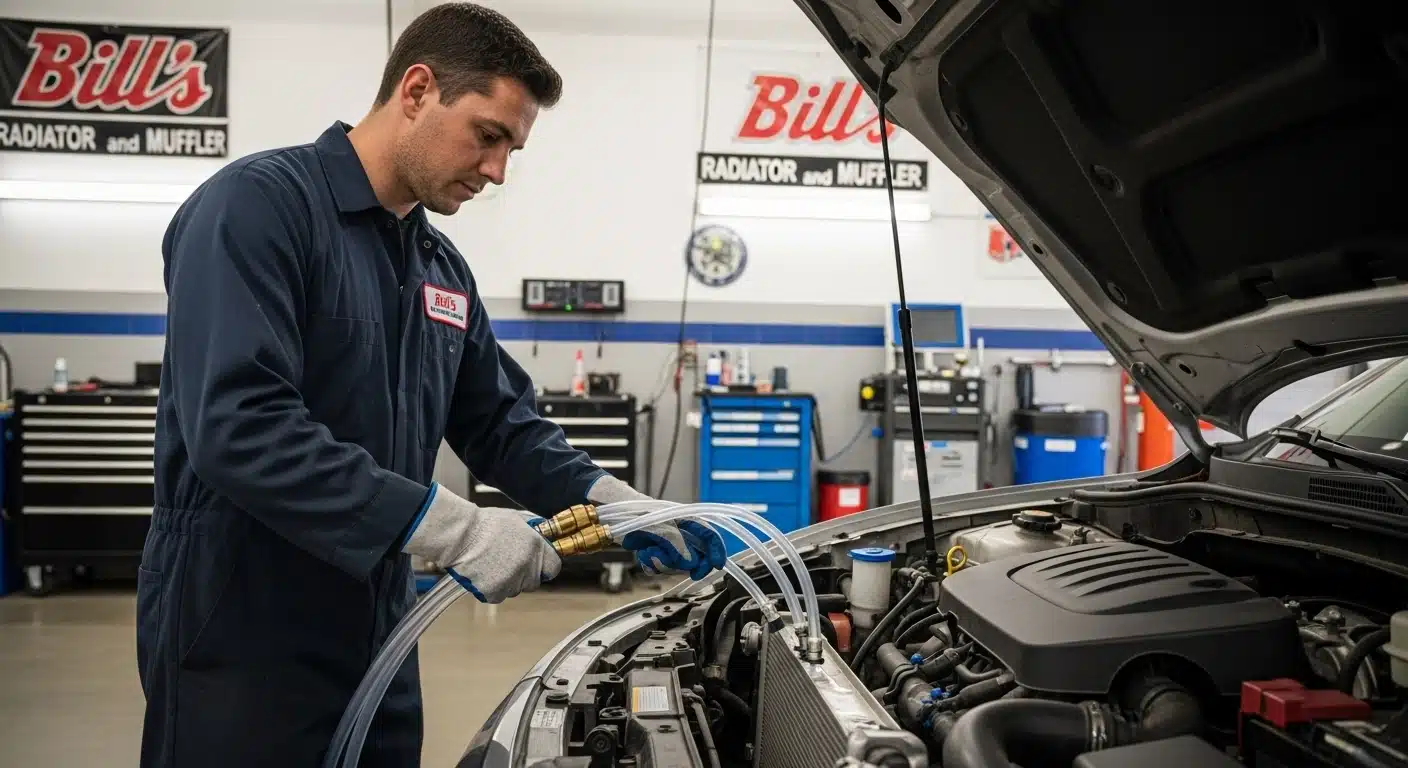
Radiator leak repair starts with finding where coolant is actually escaping – tank seams, core, hoses, radiator cap, or a nearby component. Pouring stop-leak into a Texas-heat radiator may buy a day and cost you an engine if the leak returns on the highway.
Need help today? Call Bill’s Radiator and Muffler at (972) 422-1130 or visit us at 1209 K Ave Ste B, Plano, TX 75074. Hours: Mon-Fri 9:00-17:30, Sat 8:00-13:00. Or use our contact page.
Common radiator leak sources
- Cracked plastic end tanks
- Corroded core or seam failures
- Loose or failed hose clamps
- Worn upper or lower radiator hoses
- Faulty radiator cap that cannot hold pressure
- Transmission cooler line fittings on some vehicles
How we find and fix leaks
We pressure-test the cooling system, inspect hoses and clamps, check the cap, and look for dried coolant trails. Small hose or clamp issues are straightforward. A cracked tank often means radiator replacement. We explain options before starting work.
Related guides: radiator hose replacement, radiator service, and radiator repair near me.
Frequently asked questions
Is stop-leak a permanent fix?
Rarely. It can clog heater cores and small passages. We prefer a proper mechanical repair.
What color is coolant?
Often green, orange, pink, or blue depending on formula – usually sweet-smelling, not oily black.
Can a small leak wait?
Coolant loss adds up fast in traffic. Have it checked before the temperature gauge climbs.
Finding the real leak before buying a radiator
Radiator leak repair starts with proving where coolant leaves the system. Dye, pressure testing, and careful inspection separate radiator tank cracks from hose weeping, water pump seals, heater core smells, and cap failures. Pouring stop-leak into a hot Texas cooling system is a gamble that can clog small passages.
Bill’s Radiator and Muffler specializes in cooling work through radiator service. Related reading: radiator hose replacement and overheating car repair.
Plastic tanks, seams, and core damage
Many modern radiators use plastic end tanks that crack with age and heat cycles. Seam failures and core punctures from road debris also show up. Some leaks only appear when the system is hot and pressurized, so a cold visual check is not always enough.
- Pressure-test to reveal leaks that hide when cold
- Inspect tanks, seams, fins, and mounting points
- Check hoses, clamps, and the radiator cap
- Look for transmission fluid mixing on radiators with coolers
- Explain repair versus radiator replacement before starting
After the leak is fixed
We refill with the correct coolant, bleed air, and verify the repair under temperature. You should leave knowing what failed and what to watch for on the first drives—especially gauge behavior in traffic.
More questions we hear in the shop
Is stop-leak ever okay?
We prefer mechanical repairs. Stop-leak can clog heater cores and is rarely permanent.
Why is my coolant disappearing with no puddle?
Residue may burn off on hot parts, or the leak may be small and intermittent. Testing finds it.
Can a bad cap cause overflow?
Yes. Caps that cannot hold pressure change boiling behavior and can push coolant out the reservoir.
Do you repair and replace radiators?
We recommend the option that fits the damage—hose or clamp fixes when that is enough, radiator replacement when tanks or cores are done.
Serving Plano and nearby DFW drivers
Bill’s Radiator and Muffler is at 1209 K Ave Ste B, Plano, TX 75074. We regularly see vehicles from Plano, Allen, McKinney, Richardson, Wylie, and surrounding cities. Call (972) 422-1130 during shop hours: Mon–Fri 9:00–17:30, Sat 8:00–13:00.
Bring notes about when the symptom started, whether it changes with traffic or highway speeds, and any recent cooling or exhaust work. That history shortens diagnosis time once the vehicle is in the bay.
Practical next steps
If you are dealing with these symptoms now, schedule a visit so we can inspect the vehicle in person. Phone guesses only go so far with cooling and exhaust problems. Call (972) 422-1130 or use our contact page to set a time that works with shop hours.
Bring any prior repair invoices if you have them. Knowing what was already replaced helps us avoid repeating work and focus on what still needs attention in the cooling or exhaust system.
Practical next steps
If you are dealing with these symptoms now, schedule a visit so we can inspect the vehicle in person. Phone guesses only go so far with cooling and exhaust problems. Call (972) 422-1130 or use our contact page to set a time that works with shop hours.
Bring any prior repair invoices if you have them. Knowing what was already replaced helps us avoid repeating work and focus on what still needs attention in the cooling or exhaust system.
Practical next steps
If you are dealing with these symptoms now, schedule a visit so we can inspect the vehicle in person. Phone guesses only go so far with cooling and exhaust problems. Call (972) 422-1130 or use our contact page to set a time that works with shop hours.
Bring any prior repair invoices if you have them. Knowing what was already replaced helps us avoid repeating work and focus on what still needs attention in the cooling or exhaust system.
Practical next steps
If you are dealing with these symptoms now, schedule a visit so we can inspect the vehicle in person. Phone guesses only go so far with cooling and exhaust problems. Call (972) 422-1130 or use our contact page to set a time that works with shop hours.
Bring any prior repair invoices if you have them. Knowing what was already replaced helps us avoid repeating work and focus on what still needs attention in the cooling or exhaust system.
Practical next steps
If you are dealing with these symptoms now, schedule a visit so we can inspect the vehicle in person. Phone guesses only go so far with cooling and exhaust problems. Call (972) 422-1130 or use our contact page to set a time that works with shop hours.
Bring any prior repair invoices if you have them. Knowing what was already replaced helps us avoid repeating work and focus on what still needs attention in the cooling or exhaust system.
Need help today? Call Bill’s Radiator and Muffler at (972) 422-1130 or visit us at 1209 K Ave Ste B, Plano, TX 75074. Hours: Mon-Fri 9:00-17:30, Sat 8:00-13:00. Or use our contact page.